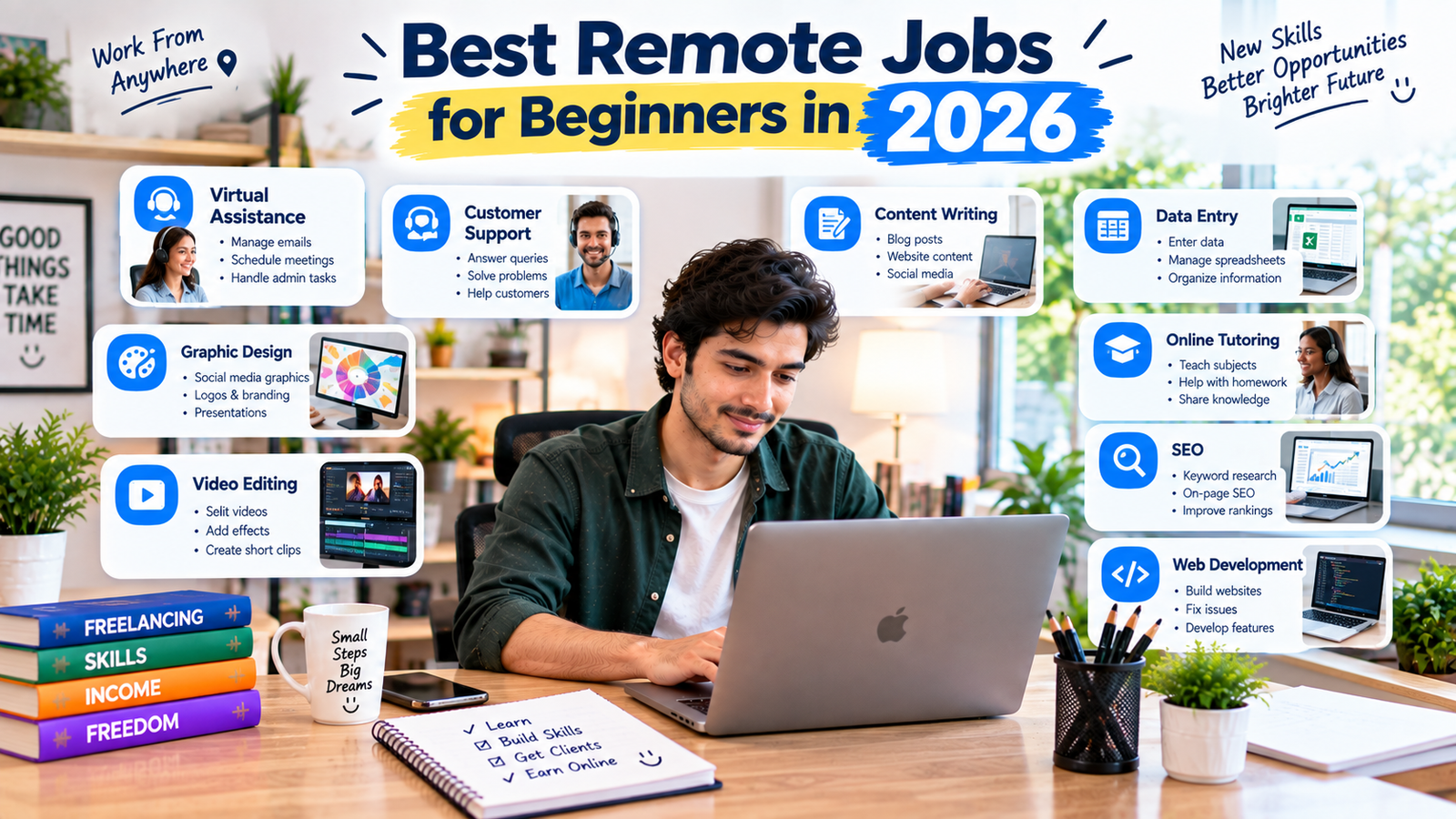
Remote work has become an attractive career option for people who want more flexibility and the ability to work from home. The good news is that you do not always need years of experience to start a remote career.
There are many remote jobs for beginners that can be learned with basic digital skills and consistent practice. Some jobs require specialized skills, while others can be started with little experience and improved over time.
In this guide, we will explore the best remote jobs for beginners in 2026, what each job involves, what skills you need, and how you can start looking for your first remote opportunity.
What Are Remote Jobs?
Remote jobs are jobs that allow you to work outside a traditional office. Depending on the company and position, you may be able to work entirely from home or from anywhere with a reliable internet connection.
Remote jobs can be full-time, part-time, contract-based, or freelance.
Common remote work categories include:
- Customer support
- Virtual assistance
- Content writing
- Data entry
- Social media management
- Graphic design
- Video editing
- Online tutoring
- Sales and marketing
- Web development
The right option depends on your skills, interests, experience, and how much time you can dedicate to learning.
Best Remote Jobs for Beginners
Here are some of the most accessible remote career options for beginners.
1. Virtual Assistant
Virtual assistants help businesses, entrepreneurs, and professionals with everyday administrative tasks.
Typical responsibilities can include:
- Managing emails
- Scheduling appointments
- Organizing files
- Updating spreadsheets
- Internet research
- Managing calendars
- Basic customer communication
You usually need good communication, organization, and basic computer skills.
2. Customer Support Representative
Many companies hire remote customer support representatives to help customers through email, live chat, or phone.
Your responsibilities may include answering questions, resolving basic problems, processing requests, and explaining products or services.
Important skills include:
- Clear communication
- Patience
- Problem-solving
- Basic computer skills
- Professional writing
If you are comfortable communicating with people, remote customer support can be a practical career option.
3. Content Writer
If you enjoy writing, content writing can be an excellent remote career.
Content writers create:
- Blog posts
- Website content
- Product descriptions
- Articles
- Social media content
- Email content
You do not necessarily need a degree in writing. What matters more is your ability to research topics, write clearly, follow instructions, and create useful content.
Start by creating a few writing samples and building a simple portfolio.
4. Data Entry Specialist
Data entry is another beginner-friendly remote job.
>Data entry workers may enter information into spreadsheets, databases, websites, or business software.
>The work can be repetitive, but it can help beginners gain professional experience with digital tools and business processes.
Useful skills include:
- Fast and accurate typing
- Attention to detail
- Microsoft Excel or Google Sheets
- Basic computer knowledge
- Organization
Be careful when searching for data-entry jobs because fake job offers and scams are common in this area.
5. Social Media Assistant
Businesses need people to help manage their social media presence.
A beginner social media assistant might:
- Schedule posts
- Write captions
- Research hashtags
- Respond to comments
- Create simple graphics
- Track basic engagement
- Organize content calendars
You can start by learning how major social platforms work and practicing with a personal or sample brand account.
Over time, you can develop this into a full social media management career.
6. Graphic Designer
Graphic design can be a strong remote career if you enjoy creative work.
Beginners can start with simple projects such as:
- Social media posts
- YouTube thumbnails
- Presentation designs
- Flyers
- Banners
- Basic marketing graphics
Tools such as Canva can help beginners start designing before moving into more advanced software.
A portfolio is especially important for design jobs. Even if you have never worked with a client, you can create sample projects to demonstrate your abilities.
7. Video Editor
The growing demand for online video has created opportunities for video editors.
Remote video editors may work on:
- YouTube videos
- Short-form videos
- Social media content
- Advertisements
- Tutorials
- Podcasts
Beginners can start by learning basic editing, cutting, transitions, subtitles, audio, and simple effects.
You can create sample videos and use them as portfolio pieces when applying for jobs.
8. Online Tutor
If you are knowledgeable about a particular subject, online tutoring can be another remote option.
You could potentially teach:
- English
- Mathematics
- Science
- Computer skills
- School subjects
- Languages
- Professional skills
Good communication and patience are important.
Depending on the platform and subject, some tutoring positions may require specific qualifications, so always check the requirements before applying.
9. SEO Assistant
Search engine optimization, commonly called SEO, helps websites improve their visibility in search engines.
An SEO beginner may help with:
- Keyword research
- Content optimization
- Competitor research
- Internal linking
- Basic SEO audits
- Content briefs
SEO takes time to learn, but it can become a valuable digital career skill.
Start with the fundamentals rather than trying to learn everything at once.
10. Junior Web Developer
Web development has a steeper learning curve than some of the jobs above, but it can offer strong long-term career potential.
Beginners can start with:
- HTML
- CSS
- JavaScript
- WordPress
- Basic website development
Instead of trying to learn every programming language, choose one path and practice consistently.
Create a few simple websites and add them to your portfolio. Practical projects can help demonstrate your skills to potential employers or clients.
How to Choose the Right Remote Job
There is no single remote job that is best for every beginner. Your ideal choice depends on your interests, current abilities, learning time, and long-term career goals.
For example:
If you enjoy writing:
Consider content writing or copywriting.
lass=”yoast-text-mark” />>If you enjoy organizing tasks:
Virtual assistance may be a good choice.
>If you like creative work:
>Graphic design or video editing could be suitable.
>If you enjoy technology:
Web development or SEO may be worth exploring.<br class=”yoast-text-mark” />>If you enjoy teaching:
Online tutoring could be an option.
>Choose one direction instead of trying to learn ten different skills at the same time.
Remote Jobs vs Freelancing
Remote jobs and freelancing are related but not exactly the same.
A remote employee usually works for one company and may have regular responsibilities, working hours, and a salary.
<p>A freelancer usually works independently and can have multiple clients or projects.
For begi
nners, both options can be useful.
If you prefer stable employment and structured responsibilit
ies, a remote job may be more suitable.
If you prefer flexibility and working with different clients, freelanci
ng may be a better fit.
You can also start freelancing while developing skills that eventually help you qualify for remote employment.
What Skills Do You Need for Remote Work?
Most remote jobs require more than technical knowledge.
Some important skills include:
Communication
You need to communicate clearly through email, chat, video calls, and other digital tools.
Time Management
Working remotely requires you to manage your own schedule and complete tasks without constant supervision.
Basic Computer Skills
You should be comfortable using browsers, email, cloud storage, documents, spreadsheets, and online communication tools.
Problem-Solving
Employers value people who can investigate problems and find reasonable solutions independently.
Reliability
Meeting deadlines and communicating when problems occur can help you build trust with your employer or clients.
How to Get Your First Remote Job
Getting your first remote job can take time, especially when you have little experience.
Start with these steps.
1. Choose One Job Category
Decide what type of work you want to pursue.
Do not apply randomly to every remote job you find.
2. Learn the Required Skills
Study the fundamentals and practice regularly.
Free tutorials, online courses, documentation, and practical projects can help you build your knowledge.
3. Create a Resume
Build a simple, professional resume focused on relevant skills.
If you do not have formal experience, highlight:
- Personal projects
- Courses
- Certifications
- Volunteer work
- Relevant skills</li>
- Portfolio projects
4. Build a Portfolio
A portfolio can demonstrate what you are capable of doing.
For example, an aspiring content writer can create three sample articles, while a beginner designer can create several social media graphics.
5. Search on Reliable Job Platforms
Look for remote positions through reputable job boards, company career pages, professional networks, and freelance platforms.
Read job descriptions carefully and research employers before sharing personal information.
6. Customize Your Applications
Avoid sending exactly the same application to every employer.
Explain why your skills are relevant to the particular position.
7. Prepare for Interviews
Remote interviews may happen through video calls, phone calls, or online assessments.
Practice explaining your skills, projects, experience, and why you want the position.
How Long Does It Take to Get a Remote Job?
There is no guaranteed timeline.
Some beginners may find opportunities relatively quickly, while others may need several weeks or months.
Your results can depend on:
-
-
- Your skill level
- The type of job
- Your resume
- Your portfolio
- Number of applications
- Interview performance
- Competition
<li>
-
Employer requirements
Instead of focusing only on how quickly you can get hired, focus on becoming a stronger candidate.
Common Mistakes Beginners Should Avoid
Applying to Everything
Applying to hundreds of unrelated jobs can waste time. Focus on positions that match your skills.
Having No Portfolio
For skill-based positions, examples of your work can make your application much stronger.
Using a Generic Resume
A resume should highlight the skills relevant to the job.
Ignoring Job Requirements
Read the entire job description before applying.
Paying for a Job
Be extremely cautious if someone asks you to pay money just to receive a job, interview, or guaranteed employment opportunity.
Expecting Instant Results</h3>
Remote work is competitive. Building skills
and finding legitimate opportunities can take time.
A Simple Beginner Roadmap
If you are starting from zero, use this roadmap:
1: Choose one remote job category.
2: Learn the basic skills.
3: Practice with small projects.
4: Create a resume and portfolio. 5: Search for legitimate remote opportunities.
6: Apply consistently.
7: Improve your applications based on feedback.
8: Continue developing your skills after getting hired.
The goal is not simply to find any remote job. The goal is to build skills that can lead to better opportunities over time.
Final Thoughts
The best remote jobs for beginners are not necessarily the ones that promise the fastest money. A better approach is to choose a job that matches your interests and gives you room to develop valuable skills.
Virtual assistance, customer support, content writing, data entry, social media assistance, graphic design, video editing, online tutoring, SEO, and web development are all potential starting points.
Choose one area, learn the fundamentals, create practical examples, and apply consistently.
With patience and continuous improvement, a beginner can gradually build the skills and experience needed for a successful remote career.