
Freelancing continues to be an attractive career option for people who want flexible working hours, remote opportunities, and the ability to work with clients from around the world. However, one important question remains for beginners: Which freelancing skills should you learn in 2026?
The freelance market is constantly changing. New technologies, artificial intelligence, digital businesses, and changing customer needs are creating new opportunities for skilled freelancers.
If you are planning to start freelancing or want to increase your income as an existing freelancer, choosing the right skill can make a major difference.
In this guide, we will look at some of the best freelancing skills to learn in 2026, why they are valuable, and how beginners can start developing them.
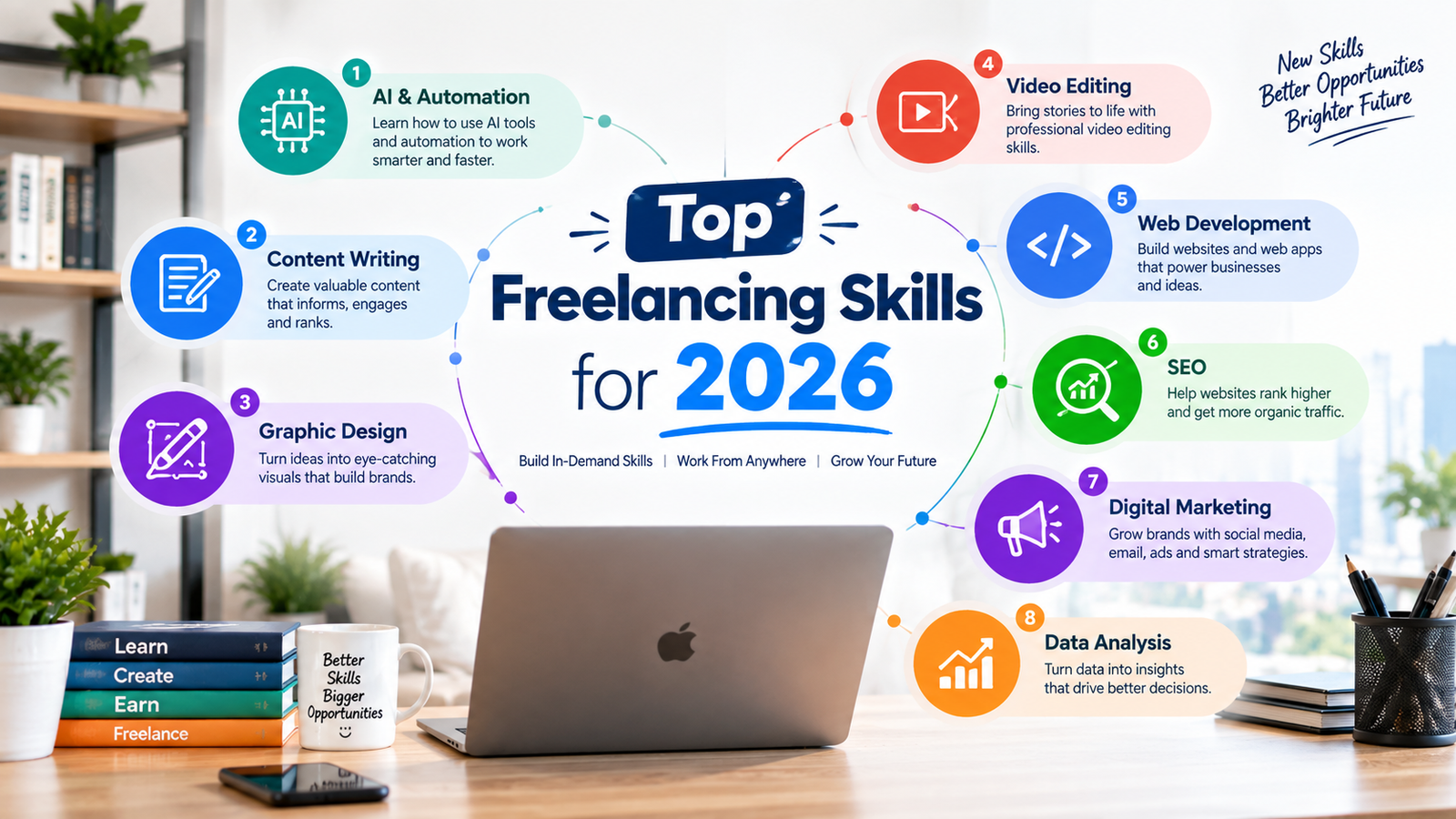
1. AI and AI Automation
Artificial intelligence has become one of the biggest developments in the digital world, and businesses are increasingly looking for people who can use AI effectively.
You don’t necessarily need to become an AI researcher or machine-learning engineer. Freelancers can provide practical AI-related services to businesses and individuals.
Some areas you can explore include:
- AI content workflows
- AI research
- AI-assisted marketing
- AI automation
- AI chatbot setup
- AI workflow optimization
- Prompt development
- AI tool consulting
Businesses want to save time and automate repetitive tasks. A freelancer who can help them use AI effectively can provide valuable services.
If you are interested in technology, AI automation can be a particularly useful skill to develop in 2026.
2. Content Writing
Content writing remains a popular freelance service because businesses need content for websites, blogs, newsletters, product pages, and social media.
A beginner can start by learning:
- Blog writing
- SEO writing
- Copywriting
- Product descriptions
- Website content
- Email writing
- Technical writing
However, content writing has become more competitive. Simply producing generic articles may not be enough.
Successful freelance writers can differentiate themselves by understanding a specific industry or niche and producing useful, well-researched content.
For example, instead of offering yourself simply as a “content writer,” you could specialize in technology, finance, SaaS, e-commerce, or another specific field.
3. Graphic Design
Businesses need visual content for websites, advertisements, social media, presentations, and branding.
Graphic design is therefore another useful freelance skill to learn.
Beginners can start with relatively simple services such as:
- Social media graphics
- YouTube thumbnails
- Presentation design
- Business flyers
- Posters
- Basic branding
- Website graphics
As you gain experience, you can move into more advanced areas such as brand identity, UI design, or visual communication.
Building a strong portfolio is particularly important for designers because clients want to see examples of your work before hiring you.
4. Video Editing
Video has become an important format for businesses, creators, influencers, and online educators.
This creates opportunities for freelance video editors.
You can offer services such as:
- YouTube video editing
- Short-form video editing
- Reels and Shorts
- TikTok videos
- Podcast editing
- Promotional videos
- Educational videos
A beginner can start by learning one editing application and practicing with sample projects.
Short-form content can also be a useful area to explore because many creators and businesses need a consistent supply of videos for social media.
5. Web Development
Web development remains one of the most valuable technical freelancing skills.
Businesses need websites for many different purposes, including e-commerce, lead generation, portfolios, blogs, and online services.
You can start with basic technologies such as:
- HTML
- CSS
- JavaScript
- WordPress
- Website builders
Later, you can learn more advanced technologies and frameworks.
Web development usually requires more learning than some beginner-friendly freelance skills, but it can also provide opportunities for higher-value projects.
6. SEO
Search engine optimization, commonly known as SEO, helps websites improve their visibility in search engines.
Businesses often need SEO because getting organic traffic can help them attract potential customers.
Freelancers can specialize in areas such as:
- Keyword research
- On-page SEO
- Technical SEO
- Content optimization
- SEO audits
- Link building
- Local SEO
SEO is a broad field, so beginners should avoid trying to master everything immediately.
Start with the fundamentals and practice by optimizing your own website or sample projects.
7. Social Media Management
Businesses need to maintain an active presence on social media, but many business owners don’t have enough time to manage their accounts.
This creates opportunities for freelance social media managers.
A social media manager may be responsible for:
- Creating content
- Scheduling posts
- Writing captions
- Researching content ideas
- Managing comments
- Tracking basic performance
- Creating content calendars
Understanding the audience and goals of a business is more important than simply posting content.
8. Virtual Assistance
Virtual assistance is another accessible option for beginners.
A virtual assistant can help businesses with administrative and online tasks such as:
- Email management
- Data organization
- Calendar management
- Internet research
- Customer support
- Spreadsheet work
- Appointment scheduling
- Basic social media tasks
The skills required depend on the client.
If you are organized, reliable, and comfortable using common online tools, virtual assistance can be a good starting point for a freelance career.
9. Digital Marketing
Digital marketing includes a wide range of activities that businesses use to attract and convert customers online.
Freelancers can specialize in areas such as:
- Email marketing
- Social media marketing
- Search marketing
- Content marketing
- Lead generation
- Marketing analytics
- Online advertising
You don’t have to learn every area at once.
Choose one specialization, develop your knowledge, and create sample campaigns to demonstrate your abilities.
10. Data Analysis
Businesses generate huge amounts of information, but raw data isn’t useful unless someone can understand it.
Data analysis involves collecting, organizing, analyzing, and presenting information in a useful way.
Freelancers interested in this field can learn:
- Excel or spreadsheet analysis
- Data visualization
- SQL
- Basic statistics
- Dashboard creation
- Business reporting
This skill generally requires more technical learning, but it can be valuable for people who enjoy working with numbers and solving problems.
11. Copywriting
Copywriting is different from general content writing.
A copywriter creates text designed to persuade people to take an action, such as buying a product, signing up for a service, or contacting a business.
Common copywriting projects include:
- Sales pages
- Advertisements
- Email campaigns
- Landing pages
- Product descriptions
- Marketing headlines
Good copywriters understand psychology, customer problems, benefits, and calls to action.
If you enjoy writing and marketing, copywriting can be an interesting freelance specialization.
12. UI/UX Design
User interface and user experience design focus on creating digital products that are attractive, easy to use, and intuitive.
UI/UX designers may work on:
- Websites
- Mobile applications
- SaaS products
- Dashboards
- Landing pages
You can start by learning design principles and tools used for interface design.
A portfolio is especially important because clients want to see how you think about design problems, not just the final visual result.
How to Choose the Best Freelancing Skill
There is no single freelancing skill that is perfect for everyone.
The right choice depends on your interests, existing abilities, learning time, and career goals.
Consider these questions before choosing a skill:
What do you enjoy?
If you enjoy writing, content writing or copywriting may be suitable. If you enjoy visual work, graphic design or video editing may be a better choice.
How long can you spend learning?
Some skills can be practiced relatively quickly, while others require months of consistent learning.
Don’t choose a skill only because someone claims it is easy to make money with.
Choose something you are willing to practice consistently.
Is there a business need?
A skill becomes valuable when it solves a real problem.
Before committing to a skill, research what businesses are actually hiring freelancers to do.
Should Beginners Learn Multiple Freelancing Skills?
It’s usually better to start with one primary skill.
For example, instead of saying:
“I do writing, graphic design, SEO, video editing, and web development.”
You could position yourself as:
“I help small businesses create SEO-friendly blog content.”
Once you become good at your primary skill, you can add complementary skills.
For example:
Content Writing + SEO
or
Graphic Design + Social Media
or
Video Editing + Short-Form Content
Combining related skills can make your overall service more valuable.
How to Learn a Freelancing Skill in 2026
You don’t need to spend a huge amount of money to begin learning.
A simple process is:
Learn → Practice → Build → Publish → Improve
Start by learning the fundamentals. Then create sample projects without waiting for a client.
For example, if you want to become a video editor, create three sample videos.
If you want to become a writer, publish several useful articles.
If you want to become a designer, create fictional branding projects.
These examples become proof of your abilities and can eventually form your freelance portfolio.
Final Thoughts
The best freelancing skills to learn in 2026 are not necessarily the skills that promise the fastest money. The best skill is one that has real demand, matches your interests, and gives you room to improve.
AI and automation, content writing, graphic design, video editing, web development, SEO, social media management, virtual assistance, digital marketing, data analysis, copywriting, and UI/UX design are all areas worth exploring.
If you’re a complete beginner, don’t try to learn everything at once.
Choose one skill, practice it consistently, build a portfolio, and start looking for clients.
Your first freelance project may take time, but developing a valuable skill can give you a foundation for a long-term freelance career.