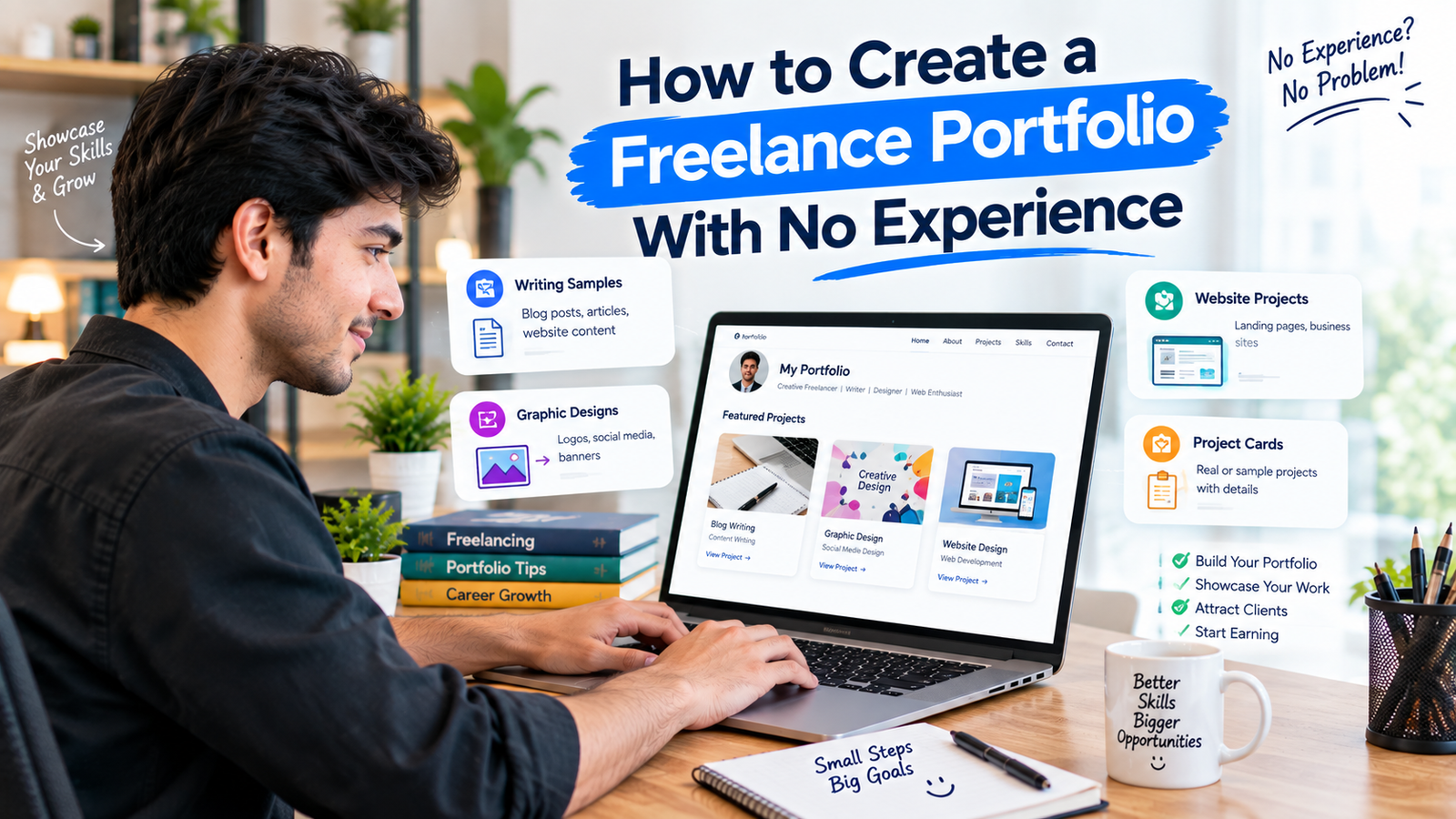
Starting freelancing without professional experience can feel difficult, especially when clients ask to see your portfolio. Many beginners think they need previous clients, paid projects, or years of experience before they can create a professional portfolio.
The good news is that you don’t need previous clients to build a strong freelance portfolio.
You can create sample projects, personal projects, mock client work, and demonstrations of your skills. A well-organized portfolio can help potential clients understand what you can do and why they should consider hiring you.
In this guide, you’ll learn how to create a freelance portfolio with no experience, what to include, where to find portfolio ideas, and how to use your portfolio to get your first freelance client.
What Is a Freelance Portfolio?
A freelance portfolio is a collection of your best work that demonstrates your skills to potential clients.
For example:
- A writer can show blog posts and articles.
- A graphic designer can show logos, social media designs, and posters.
- A web developer can show websites and landing pages.
- A video editor can show edited videos.
- An SEO freelancer can show sample keyword research and SEO reports.
- A virtual assistant can show spreadsheets, research work, and organizational examples.
Your portfolio doesn’t necessarily need to contain work you completed for paying clients.
For beginners, the most important thing is demonstrating what you are capable of doing.
Can You Create a Freelance Portfolio With No Experience?
Yes, absolutely.
You can build a portfolio even if you’ve never worked with a client before.
Instead of showing previous client projects, create sample projects that represent the type of work you want to get hired for.
For example, if you want to become a freelance content writer, you could create:
- A 1,000-word blog article
- A product description
- A comparison article
- An SEO-friendly article
- A social media caption set
These projects give clients something concrete to evaluate.
The goal isn’t to pretend that sample work is real client work. Clearly label it as sample work, personal work, or practice work.
1. Choose One Freelance Skill
Before creating your portfolio, decide what service you want to offer.
Avoid trying to create a portfolio for ten different skills at the beginning. A focused portfolio usually looks more professional.
Some beginner-friendly freelance skills include:
- Content writing
- Copywriting
- Graphic design
- Video editing
- Social media management
- Web development
- WordPress
- SEO
- Virtual assistance
- Data entry
- Data analysis
- AI-assisted content creation
Choose one primary skill and build your portfolio around it.
For example, instead of saying:
“I provide writing, graphic design, SEO, video editing, and web development.”
You could position yourself as:
“Freelance SEO Content Writer helping businesses create useful, search-friendly blog content.”
A specific service makes it easier for potential clients to understand what you offer.
2. Create Sample Projects
This is one of the best ways to build a portfolio without experience.
Think about the type of client you want to work with and create projects specifically for that audience.
For example, suppose you want to become a freelance graphic designer for restaurants.
You could create:
- A restaurant logo
- A menu design
- Three Instagram posts
- A promotional flyer
- A food delivery advertisement
You don’t need a real restaurant to create these designs.
Similarly, if you’re interested in freelance web development, create a fictional business website and demonstrate your skills through the project.
Example
Imagine you want to work with fitness businesses.
Create a sample project such as:
“Fitness Studio Website Landing Page”
Then include:
- Project objective
- Design concept
- Technologies used
- Screenshots
- Key features
- Final result
This looks much more professional than simply saying, “I know HTML, CSS, and JavaScript.”
3. Create Personal Projects
Personal projects are another excellent way to demonstrate your abilities.
Build something that you’re genuinely interested in and use it as a portfolio piece.
For example:
A writer could start a small blog.
A designer could create a fictional brand identity.
A developer could build a simple website.
A video editor could create a short promotional video.
An SEO beginner could conduct keyword research for a fictional website.
Personal projects show initiative and give clients evidence that you can complete real work.
4. Build 3–5 Strong Portfolio Pieces
You don’t need 20 projects when you’re starting.
In fact, a portfolio with three to five excellent projects can be better than one containing dozens of weak examples.
Focus on quality and relevance.
Each project should demonstrate a different aspect of your skill.
For example, a content writer might create:
Project 1: SEO blog article
Project 2: Product descriptions
Project 3: Listicle article
Project 4: Website landing page copy
Project 5: Email newsletter
This gives clients a better understanding of your capabilities.
5. Make Your Portfolio Look Professional
Your portfolio doesn’t need an expensive website.
You can start with a simple portfolio using platforms such as a personal website, Google Drive, Notion, or other portfolio platforms.
The important thing is organization.
For each project, include:
Project Title
Explain what the project is.
Objective
Describe what the project was designed to accomplish.
Your Work
Show the actual result.
Tools Used
Mention relevant tools or software.
Skills Demonstrated
Explain what skills the project demonstrates.
Result
If it’s a fictional project, don’t invent business results. Instead, explain what the project successfully demonstrates.
For example:
“This sample demonstrates my ability to create SEO-friendly long-form content with clear headings, keyword placement, and reader-focused structure.”
6. Don’t Copy Other People’s Work
When you’re creating a portfolio with no experience, it can be tempting to download designs or copy articles from the internet.
Don’t do it.
Your portfolio should contain work that you created yourself.
You can study other people’s work for inspiration, but your final projects should be original.
This is important because clients may ask you questions about your portfolio. You need to be able to explain exactly how you created each project.
7. Show Your Process
Clients don’t only want to see the final product. They may also want to understand how you work.
Showing your process can make a beginner portfolio much stronger.
For example, a writer could show:
Research → Keyword Selection → Outline → First Draft → Editing → Final Article
A designer could show:
Research → Ideas → Wireframe → Design → Revisions → Final Design
A developer could show:
Planning → Design → Development → Testing → Final Website
This demonstrates that you understand the workflow behind your service.
8. Create a Simple Portfolio Introduction
Your portfolio should start with a short introduction.
Don’t write a long autobiography.
Instead, tell visitors:
- Who you are
- What service you provide
- Who you help
- What makes your approach useful
For example:
“I’m a freelance content writer specializing in SEO-friendly blog content for small businesses and online brands. I create clear, engaging, and well-structured articles designed to provide value to readers and support search visibility.”
Keep your introduction simple and professional.
9. Include Your Best Work First
The first project people see can make a strong impression.
Put your strongest and most relevant work near the beginning of your portfolio.
If you’re applying for a technology writing job, don’t make your best technology article the tenth project.
Put relevant work first.
Your portfolio should be organized around the type of clients you want to attract.
10. Use Your Portfolio to Apply for Freelance Jobs
Creating a portfolio is only half the process.
You also need to use it when applying for jobs.
When sending a freelance proposal, don’t simply write:
“Here is my portfolio.”
Instead, explain why a particular sample is relevant.
For example:
“I recently created an SEO-focused article about personal finance that demonstrates my ability to structure long-form content, research topics, and write for online readers. I’ve included it in my portfolio because it closely matches the type of content you’re looking for.”
This makes your portfolio more useful during client communication.
Where Should You Put Image 2?
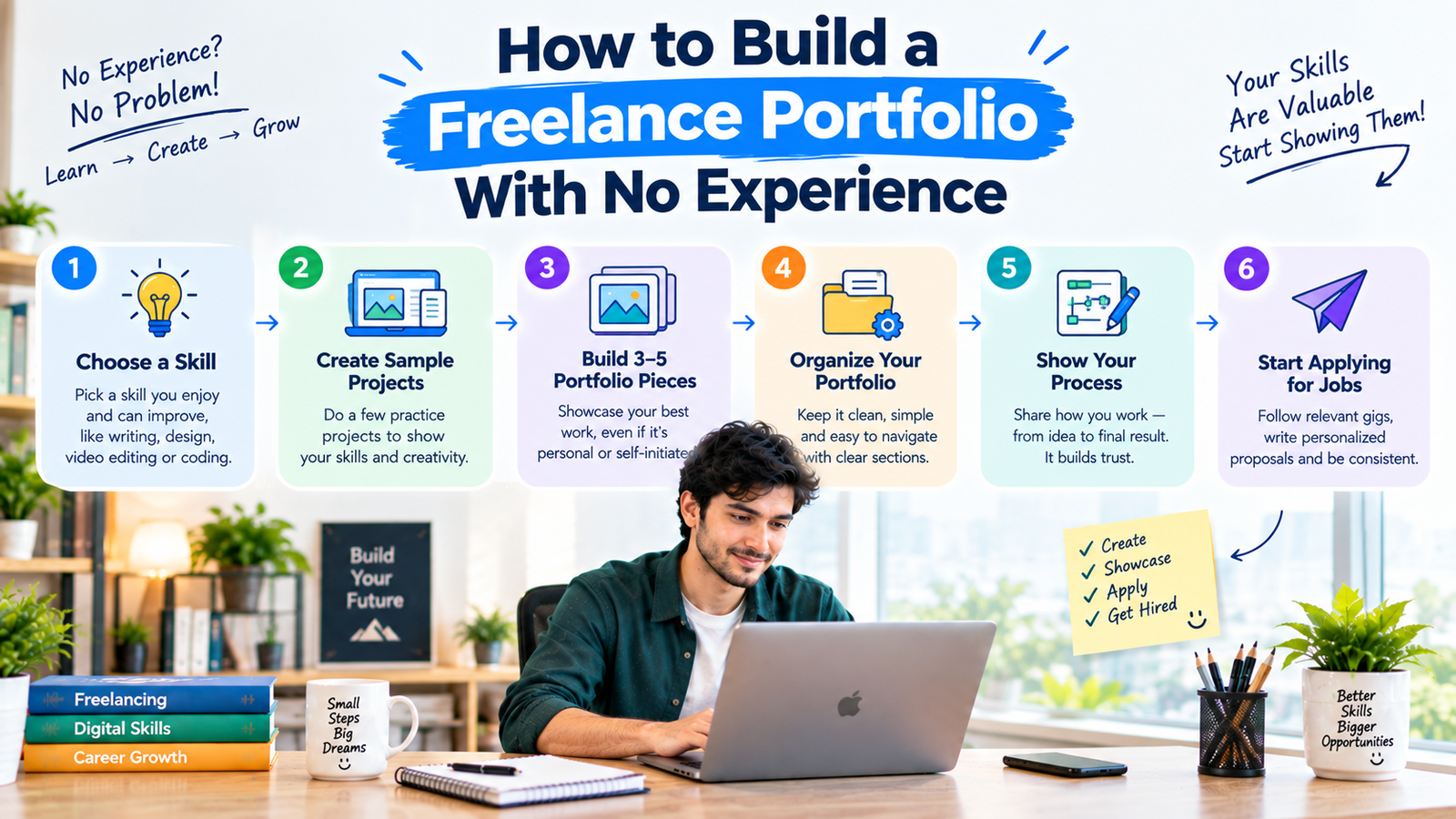
Place Image 2 immediately under the heading “How to Create Sample Projects”, after the first paragraph:
“This is one of the best ways to build a portfolio without experience. Think about the type of client you want to work with and create projects specifically for that audience.”
Then insert Image 2.
After the image, continue with:
“For example, suppose you want to become a freelance graphic designer for restaurants.”
This placement works well because the infographic visually explains the portfolio-building process before the article moves into practical examples.
11. Ask for Feedback
Even if you don’t have clients yet, you can ask people to review your sample work.
Ask friends, classmates, colleagues, online communities, or experienced freelancers for constructive feedback.
Ask questions such as:
- Is the work easy to understand?
- Does it look professional?
- What could be improved?
- Is the writing/design clear?
- Would this portfolio make you consider hiring me?
Feedback can help you improve your portfolio before approaching real clients.
12. Update Your Portfolio Regularly
Your first portfolio won’t be your final portfolio.
As you gain experience, replace weaker samples with better projects.
Once you complete real client projects and have permission to display them, gradually add relevant client work.
Over time, your portfolio should become more focused and professional.
You may eventually specialize in a specific industry or service.
For example:
“SEO writer for SaaS companies”
or:
“Graphic designer for e-commerce brands”
Specialization can make your portfolio more attractive to specific clients.
Common Portfolio Mistakes Beginners Should Avoid
When creating a freelance portfolio, avoid these common mistakes:
Too Many Skills
Don’t list every skill you’ve ever learned.
Focus on the services you actually want to sell.
Low-Quality Samples
Three excellent projects are better than ten unfinished ones.
Fake Experience
Never claim that fictional projects were completed for real clients.
Be honest and label sample projects appropriately.
No Explanation
Don’t simply upload an image or document.
Explain the purpose and skills demonstrated by the project.
Poor Organization
Make your portfolio easy to navigate.
Clients should quickly find your best work.
No Contact Information
Make it easy for interested clients to contact you.
Include a professional email address or appropriate contact method.
How Long Does It Take to Build a Portfolio?
You can create a basic freelance portfolio in one to two weeks if you focus consistently.
For example:
Day 1: Choose your freelance skill
Days 2–4: Create your first sample
Days 5–7: Create your second sample
Days 8–10: Create your third sample
Days 11–12: Organize your portfolio
Days 13–14: Improve your profile and start applying
You don’t need to wait until your portfolio is perfect before looking for clients.
Start applying once you have a few strong, relevant examples.
Final Thoughts
Learning how to create a freelance portfolio with no experience is one of the most important steps for beginners who want to start freelancing.
You don’t need previous clients to prove your skills.
Start by choosing one service, create three to five relevant sample projects, organize them professionally, explain your process, and use your portfolio when applying for freelance jobs.
Your first portfolio may not be perfect—and that’s okay.
The goal is to create enough evidence of your ability that a potential client can confidently say:
“This freelancer can do the work I need.”
Once you land your first project, deliver excellent work, collect feedback, and continue improving your portfolio. With consistent effort, your beginner portfolio can gradually become a powerful tool for building a successful freelance career.