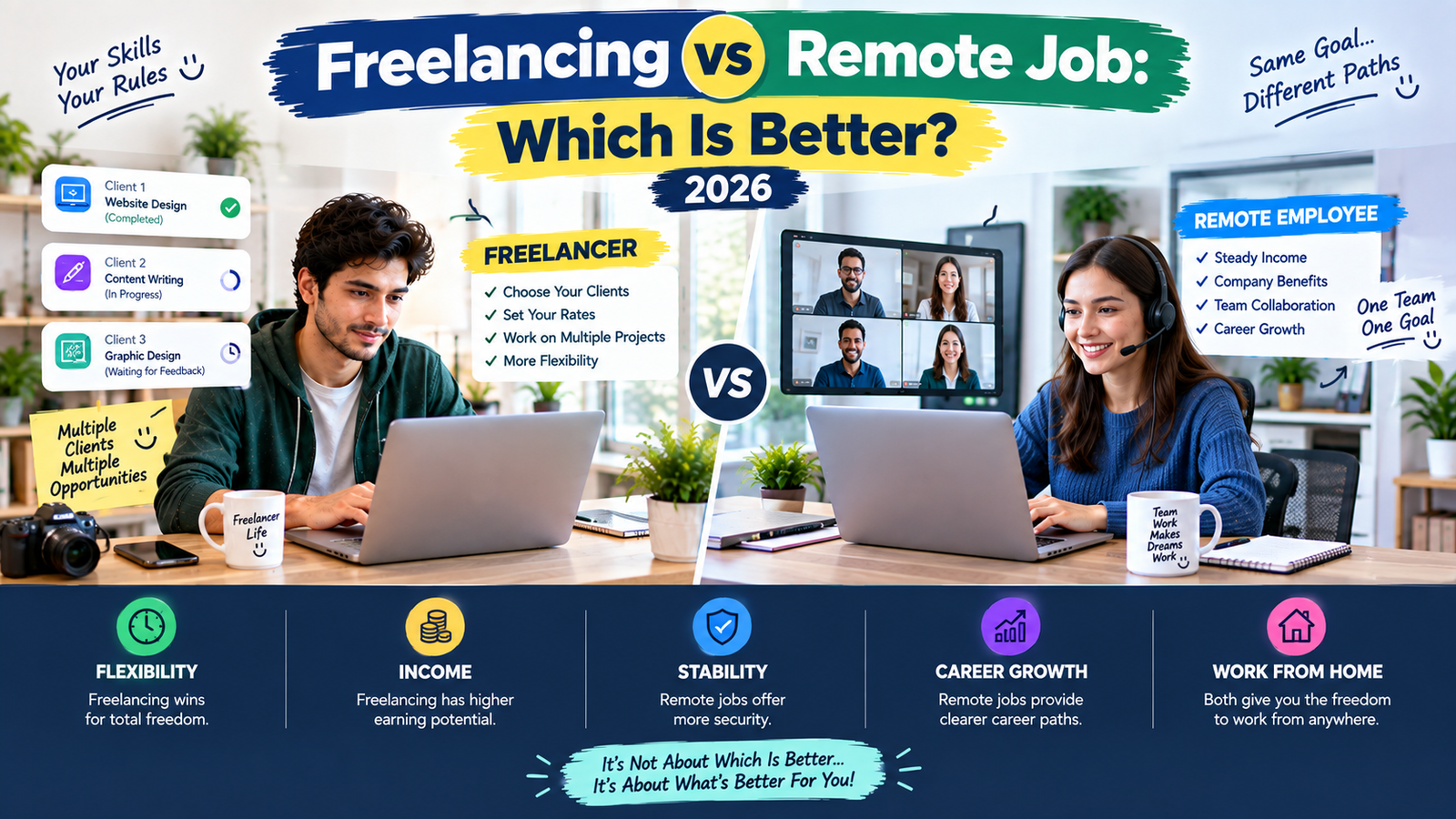
The way people work has changed significantly, and today you have more career options than simply working in a traditional office. Two popular choices are freelancing and remote jobs.
Both can allow you to work from home, earn money online, and build a flexible career. However, freelancing and remote employment are not the same.
A remote employee typically works for one company, while a freelancer usually works independently with multiple clients or projects.
So, freelancing vs remote job: which is better?
The answer depends on your goals, skills, income expectations, work style, and how much stability or flexibility you want.
In this guide, we will compare freelancing and remote jobs and help you decide which option may be better for you.
What Is Freelancing?
Freelancing means working independently and providing services to clients or businesses.
Instead of being a permanent employee of one company, a freelancer usually works on individual projects or ongoing contracts.
Common freelance services include:
- Content writing
- Graphic design
- Video editing
- Web development
- SEO
- Social media management
- Virtual assistance
- Digital marketing
- Translation
- Data analysis
Freelancers can find clients through freelance platforms, networking, social media, referrals, and direct outreach.
What Is a Remote Job?
A remote job is an employment position that allows you to work outside a traditional office.
You are usually hired by a company and work as part of its team.
Depending on the employer, you may have:
- Regular working hours
- A fixed salary
- Company meetings
- Specific responsibilities
- A manager or supervisor
- Employee benefits
Remote jobs can be full-time, part-time, temporary, or contract-based.
Freelancing vs Remote Job: Main Difference
The biggest difference is the employment relationship.
A freelancer is an independent service provider who works for clients.
A remote employee works for an employer, even though they may perform their job from home or another location.
For example, imagine you are a graphic designer.
As a freelancer, you might have five different clients and charge each client for individual projects.
As a remote employee, you might work as a graphic designer for one company and receive a regular salary.
Both can be remote, but the structure is different.
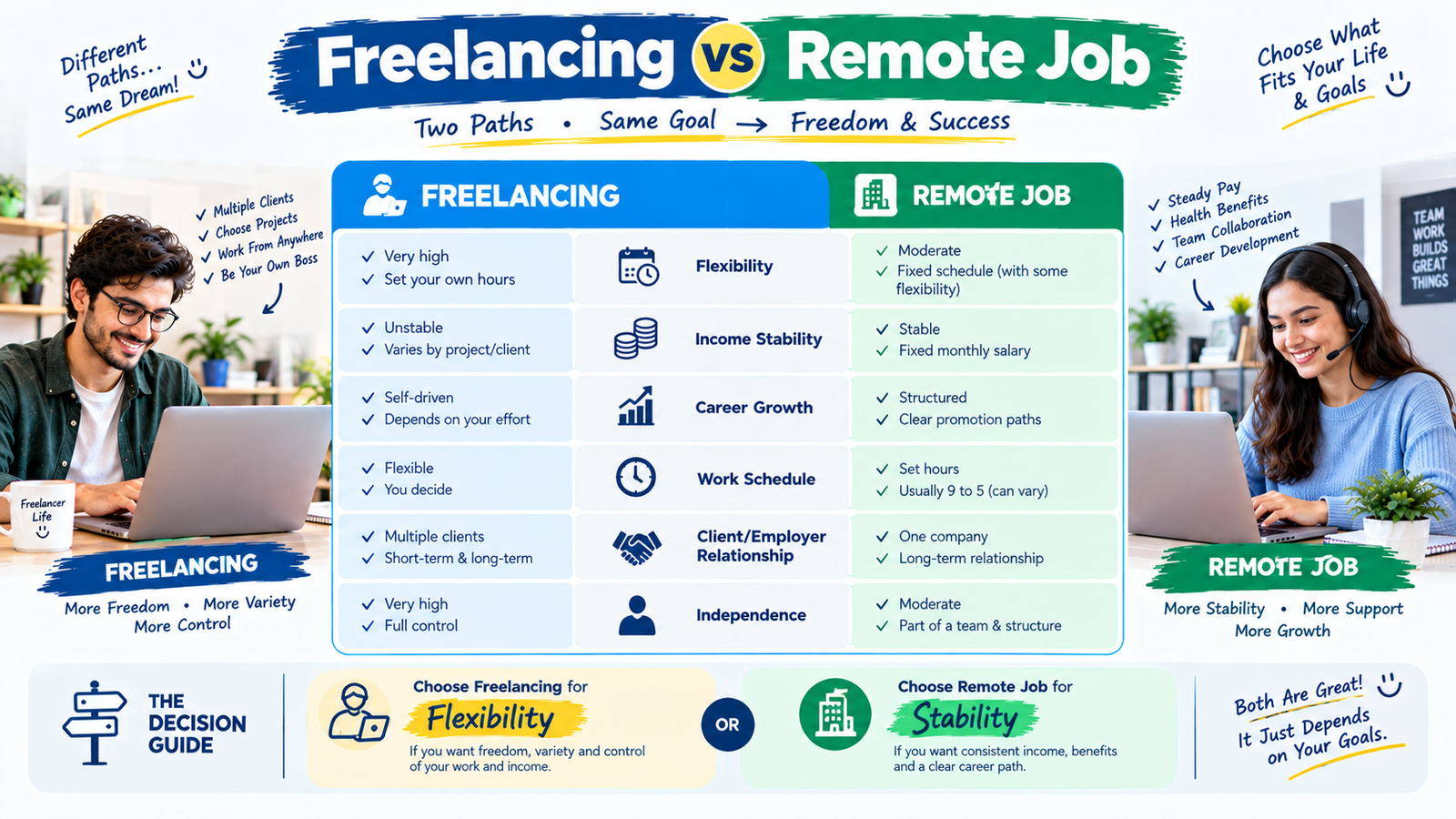
Freelancing vs Remote Job Comparison
| Factor | Freelancing | Remote Job |
|---|---|---|
| Employer | Usually multiple clients | Usually one employer |
| Income | Can vary | Usually more predictable |
| Flexibility | Usually high | Depends on employer |
| Working hours | Often flexible | Often scheduled |
| Job security | Can vary | Generally more structured |
| Client management | Freelancer handles it | Company handles clients |
| Benefits | Usually self-managed | May include company benefits |
| Career growth | Self-directed | Often company-defined |
| Workload | Can fluctuate | Usually more consistent |
| Freedom | High | Depends on company |
Which Offers More Flexibility?
Freelancing generally offers more flexibility.
As a freelancer, you may have more control over:
- Which clients you work with
- Which projects you accept
- Your working hours
- Your services
- Your pricing
- Where you work
However, flexibility comes with responsibility.
You also need to manage client communication, deadlines, invoices, marketing, and finding new projects.
A remote employee may have less control over their schedule because the company determines working hours and responsibilities.
If maximum independence is your priority, freelancing may be more suitable.
Which Offers More Income Potential?
Both freelancing and remote employment can lead to strong income, but the way you earn money is different.
A remote employee usually receives a predetermined salary.
A freelancer can increase income by:
- Getting more clients
- Increasing rates
- Offering additional services
- Working on higher-value projects
- Building long-term client relationships
- Specializing in a profitable niche
However, freelance income can fluctuate.
A freelancer may have a very profitable month followed by a slower month.
A remote employee generally has more predictable income.
Therefore, freelancing may offer greater income flexibility, while remote employment often provides greater income predictability.
Which Is More Stable?
For many people, a traditional remote job offers greater stability.
You may receive a regular paycheck and, depending on the employer, benefits such as paid time off, insurance, retirement contributions, or other employee benefits.
Freelancers usually have to manage these areas themselves.
They are also responsible for finding enough work to maintain their income.
If financial predictability is one of your highest priorities, a remote job may be the better option.
Which Is Better for Beginners?
Both options can work for beginners.
However, the better choice depends on your current skills and career goals.
Freelancing can be easier to enter in some skill categories because you can create a profile, build sample projects, and start applying for smaller projects without waiting for a traditional hiring process.
Remote employment may require a resume, interviews, assessments, and sometimes previous experience.
On the other hand, some companies actively hire entry-level remote workers and provide training.
If you want to start independently and build experience through smaller projects, freelancing can be attractive.
If you prefer structured employment and a regular team environment, a remote job may be better.
Which Requires More Responsibility?
Freelancing usually requires more business responsibility.
As a freelancer, you are not only doing the actual work.
You may also need to:
- Find clients
- Write proposals
- Negotiate prices
- Manage contracts
- Send invoices
- Track income
- Handle customer service
- Promote your services
- Manage your schedule
A remote employee generally focuses more directly on their assigned responsibilities.
The company handles many business-related tasks.
This makes remote employment simpler for people who prefer to focus on their profession rather than running a small independent business.
Which Has Better Career Growth?
Both can provide career growth, but the path is different.
Freelancing Career Growth
A freelancer can grow by becoming a specialist.
For example:
Beginner Writer → SEO Writer → SEO Specialist → Content Strategist
Or:
Beginner Designer → Brand Designer → Creative Specialist → Design Consultant
You can also build an agency and eventually work with other freelancers.
Remote Job Career Growth
A remote employee can progress through a company structure.
For example:
Junior Employee → Specialist → Senior Specialist → Team Lead → Manager
Career progression depends heavily on the organization and available positions.
Which Is Better for Work-Life Balance?
This depends on how you manage your work.
Freelancing gives you greater control over your schedule, but freelancers can sometimes work longer hours because they are responsible for finding clients and completing projects.
Remote employees may have clearer working hours, but some companies expect employees to be available during specific times.
Neither option automatically guarantees a better work-life balance.
The key is setting boundaries and managing your workload.
Freelancing vs Remote Job: Pros and Cons
Freelancing Pros
- High flexibility
- Ability to choose clients
- Potential to work on multiple projects
- Control over pricing
- Opportunity to build a personal brand
- Can work with clients from different markets
Freelancing Cons
- Income can fluctuate
- Finding clients can be difficult
- No guaranteed workload
- You manage your own business responsibilities
- Benefits usually need to be handled independently
Remote Job Pros
- More predictable income
- Structured responsibilities
- Regular team environment
- Potential employee benefits
- Clear career progression
- Less need to find clients yourself
Remote Job Cons
- Less control over working hours
- Usually one employer
- Company policies apply
- Job security depends on the employer
- Less control over projects and workload
How to Decide Between Freelancing and a Remote Job
There is no universally better choice. The right option depends on your personality, financial goals, skills, and preferred way of working.
Consider the following questions:
Do You Want Maximum Flexibility?
If you want to choose your clients, projects, and working schedule, freelancing may be a better fit.
Do You Prefer Stable Income?
If predictable income and structured employment are more important, consider a remote job.
Do You Enjoy Finding Clients?
Freelancers need to continuously develop their client pipeline.
If you enjoy networking, sales, and building relationships, freelancing may suit you.
Do You Prefer Working in a Team?
If you like collaborating with coworkers and having a manager or team structure, remote employment may be more comfortable.
Do You Want to Build Your Own Business?
Freelancing can eventually grow into an agency, consulting business, or personal brand.
If entrepreneurship interests you, freelancing provides more control.
Can You Do Both?
Yes.
You do not necessarily have to choose only one.
>Some people work full-time remote jobs while building freelance skills on the side, provided their employment agreement allows it and there is no conflict of interest.
>For example, you could have a remote marketing job while taking a few freelance writing projects during your available time.
>This can allow you to develop freelance experience while maintaining a more predictable primary income.
>However, avoid overloading yourself. Your employment responsibilities should always remain a priority, and you should understand any company policies regarding outside work.
Freelancing vs Remote Job for Work From Home
Both options can allow you to work from home.
The important difference is who controls the work arrangement.
With freelancing, you have greater independence.
With a remote job, the employer generally determines the role, expectations, schedule, and processes.
If your primary goal is simply to avoid commuting and work from home, either option can work.
If your goal is maximum independence, freelancing may be more attractive.
Which One Should You Choose?
Use this simple guide:
Choose freelancing if you:
- Want flexibility
- Like working independently
- Are comfortable with variable income
- Want multiple clients
- Enjoy building your own business
- Want control over your rates and services
Choose a remote job if you:
- Prefer predictable income
- Want structured responsibilities
- Like working as part of a team
- Prefer an employer-managed environment
- Want potential employee benefits
- Prefer a clearer career path
A Simple Strategy for Beginners
If you are completely new to online work, you can start by developing one valuable skill.
For example:
- Writing
- Graphic design
- Video editing
- SEO
- Web development
- Virtual assistance
Build a few practical projects and create a professional resume or portfolio.
Then explore both freelance projects and entry-level remote positions.
After gaining experience, you will have a better understanding of which work style suits you.
Final Thoughts
The freelancing vs remote job debate does not have one universal answer.
>Freelancing provides greater independence and flexibility, but you also have to manage clients, income, and business responsibilities.
>A remote job generally provides more structure and predictable income, but you may have less control over your schedule and work.
>For beginners, the best approach is to understand your priorities before making a decision.
>If you value freedom and flexibility, freelancing may be the better choice.
>If you value stability and structure, a remote job may be more suitable.
>And if you are unsure, you can develop your skills while exploring both paths. The experience you gain from either option can help you build a stronger digital career.