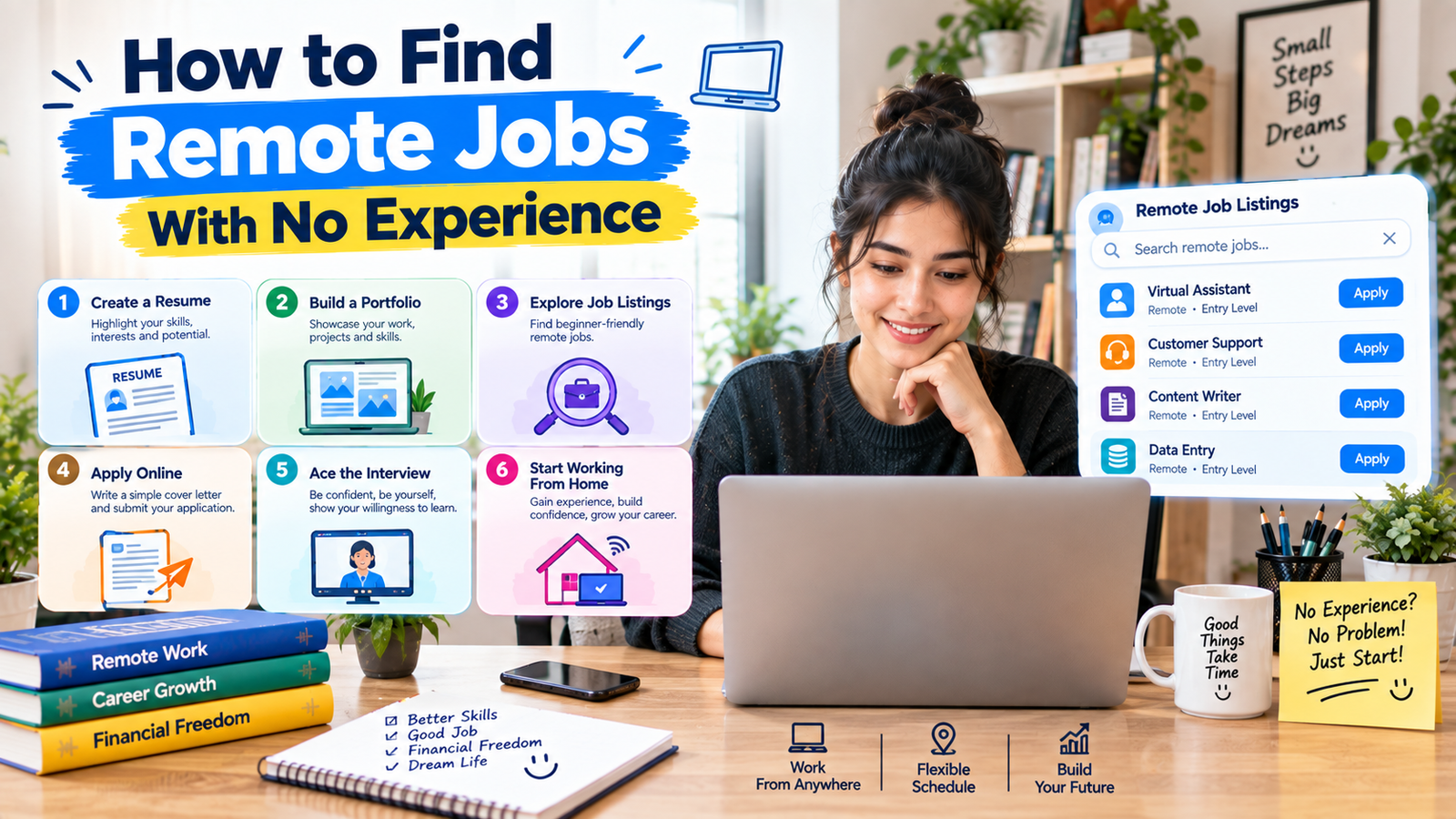
Finding a remote job with no professional experience can feel difficult, especially when many job descriptions ask for previous work experience. However, having no formal experience does not mean you cannot start a remote career.
Many entry-level remote positions focus on skills, communication, reliability, and willingness to learn. If you know where to look and how to present your abilities, you can improve your chances of finding a legitimate remote job.
In this guide, you will learn how to find remote jobs with no experience, what jobs beginners can consider, how to create a strong resume, where to search, and how to apply effectively.
Can You Really Get a Remote Job With No Experience?
Yes, it is possible to find remote work without traditional professional experience.
However, you should understand the difference between having no job experience and having no useful skills.
You may already have skills from:
- School or college projects
- Personal projects
- Volunteer work
- Freelancing
- Internships
- Helping a family business
- Online courses
- Managing social media
- Writing or creating content
- Using spreadsheets or office software
The key is to identify your transferable skills and show employers how you can use them.
Best Remote Jobs With No Experience
Some remote positions are more accessible to beginners than others.
1. Virtual Assistant
Virtual assistants help businesses with administrative and organizational tasks.
You may be responsible for:
- Managing emails
- Scheduling appointments
- Updating spreadsheets
- Internet research
- Organizing files
- Basic customer communication
Strong organization and communication skills can help you get started.
2. Customer Support
Remote customer support jobs can be suitable for people with good communication and problem-solving skills.
You may communicate with customers through:
- Live chat
- Phone
- Support platforms
Some employers provide training, making certain entry-level positions accessible to beginners.
3. Data Entry
Data entry involves entering and organizing information in spreadsheets, databases, or business systems.
Accuracy and attention to detail are important.
Basic knowledge of tools such as Google Sheets or Microsoft Excel can make you a stronger candidate.
4. Content Writing
If you have strong writing skills, you can look for entry-level content writing opportunities.
You can create sample articles even if you have never worked for a client.
A small portfolio can demonstrate your ability to write clearly and organize information.
5. Social Media Assistant
Businesses often need help managing social media content.
Beginner tasks can include:
- Scheduling posts
- Writing captions
- Finding content ideas
- Responding to comments
- Creating simple graphics
- Organizing content calendars
If you already understand social media platforms, you may have useful transferable skills.
6. Online Tutor
If you are good at a particular subject, online tutoring may be an option.
Depending on the position, you might teach school subjects, languages, computer skills, or other areas you understand well.
Some tutoring jobs may require specific qualifications, so check the requirements carefully.
7. Junior Web or WordPress Assistant
If you are interested in technology, you can learn basic website development or WordPress.
Beginners can create simple websites as practice projects and use them as portfolio examples.
This approach allows you to demonstrate practical ability even without previous employment.
How to Find Remote Jobs With No Experience
Now let’s look at a practical process you can follow.
1. Choose One Type of Remote Job
One of the biggest mistakes beginners make is trying to apply for every remote job they see.
Instead, choose one or two job categories.
For example:
- Virtual assistant
- Customer support
- Content writer
- Data entry
- Social media assistant
- Junior web assistant
Choosing a specific direction makes it easier to learn the required skills and create a targeted resume.
2. Learn the Basic Skills
Before applying, spend some time understanding the skills employers expect.
For example, a virtual assistant may need to know:
- Email management
- Google Docs
- Google Sheets
- Calendar management
- Online research
A content writer may need:
- Research
- Grammar
- SEO basics
- Content structure
- Editing
You do not need to master everything before applying, but you should understand the fundamentals.
3. Build Experience Through Personal Project
If you have no professional experience, create your own projects.
This is one of the best ways to demonstrate what you can actually do.
For example:
Content writer: Create three sample blog posts.
Graphic designer: Design five social media posts.
Virtual assistant: Create a sample spreadsheet and task-management system.
Social media assistant: Build a sample one-week content calendar.
Web developer: Create two simple websites.
These projects can become evidence of your skills.
4. Create a Beginner-Friendly Resume
Your resume does not need to be packed with years of employment history.
Instead, focus on relevant skills and evidence of your ability.
Include:
- Professional summary
- Relevant skills
- Education
- Courses or certifications
- Personal projects
- Volunteer experience
- Freelance work
- Portfolio link
Avoid writing a long explanation about why you have no experience.
Focus on what you can do.
5. Create an Online Portfolio
A portfolio can be especially valuable for beginners.
It gives employers something concrete to evaluate.
Your portfolio can include:
- Writing samples
- Designs
- Websites
- Spreadsheet examples
- Social media content
- Video projects
- Research projects
You do not need dozens of projects.
Start with three to five strong examples.
How to Present Your Skills Without Work Experience
Instead of saying:
“I have no experience.”
Try to demonstrate your abilities through projects.
For example:
Weak approach:
“I don’t have any experience as a content writer.”
Better approach:
“I have created several research-based articles and blog samples focused on different topics.”
The second approach gives the employer evidence instead of simply highlighting your lack of experience.
6. Search on Reliable Remote Job Platforms
Once your resume and portfolio are ready, start searching for opportunities.
Look for jobs through:
- Company career pages
- Reputable job boards
- Professional networking platforms
- Freelance marketplaces
- Remote-work websites
Use search terms such as:
- “Entry level remote jobs”
- “Remote jobs no experience”
- “Remote customer support”
- “Junior virtual assistant”
- “Remote data entry”
- “Entry level content writer”
- “Remote social media assistant”
Always research the company before applying.
7. Apply for Entry-Level Positions
Do not focus only on jobs with titles such as “Remote Specialist” or “Senior.”
Look for terms such as:
- Entry level
- Junior
- Assistant
- Trainee
- Associate
- Coordinator
- Intern
These keywords can help you find positions that may be more suitable for beginners.
8. Customize Your Resume for Each Job
You do not need to completely rewrite your resume every time.
But you should adjust it to emphasize the skills that matter for the particular position.
For example, if you are applying for a customer support role, highlight:
- Communication
- Problem-solving
- Customer interaction
- Written communication
- Computer skills
If you are applying for a virtual assistant position, highlight:
- Organization
- Scheduling
- Research
- Spreadsheets
- Email management
This makes your application more relevant.
9. Write a Strong Application Message
When applying online, avoid sending a one-line message such as:
“Hello, I want this job. Please hire me.”
Instead, briefly explain:
- What position you are applying for.
- Which relevant skills you have.
- What experience or projects demonstrate those skills.
- Why you are interested in the role.
Keep the message professional and focused.
10. Prepare for Remote Interviews
Getting an interview is a major step.
Before the interview, research the company and understand the position.
Prepare answers for common questions such as:
- Tell me about yourself.
- Why do you want this remote job?
- Why should we hire you?
- What are your strengths?
- How do you manage your time?
- How do you handle deadlines?
- What tools have you used?
- How would you handle a difficult customer?
You do not need to pretend you have experience you don’t have.
Be honest while explaining your skills and willingness to learn.
Where Should Beginners Focus Their Efforts?
Finding a remote job becomes easier when you follow a clear process instead of applying randomly.
A simple strategy is:
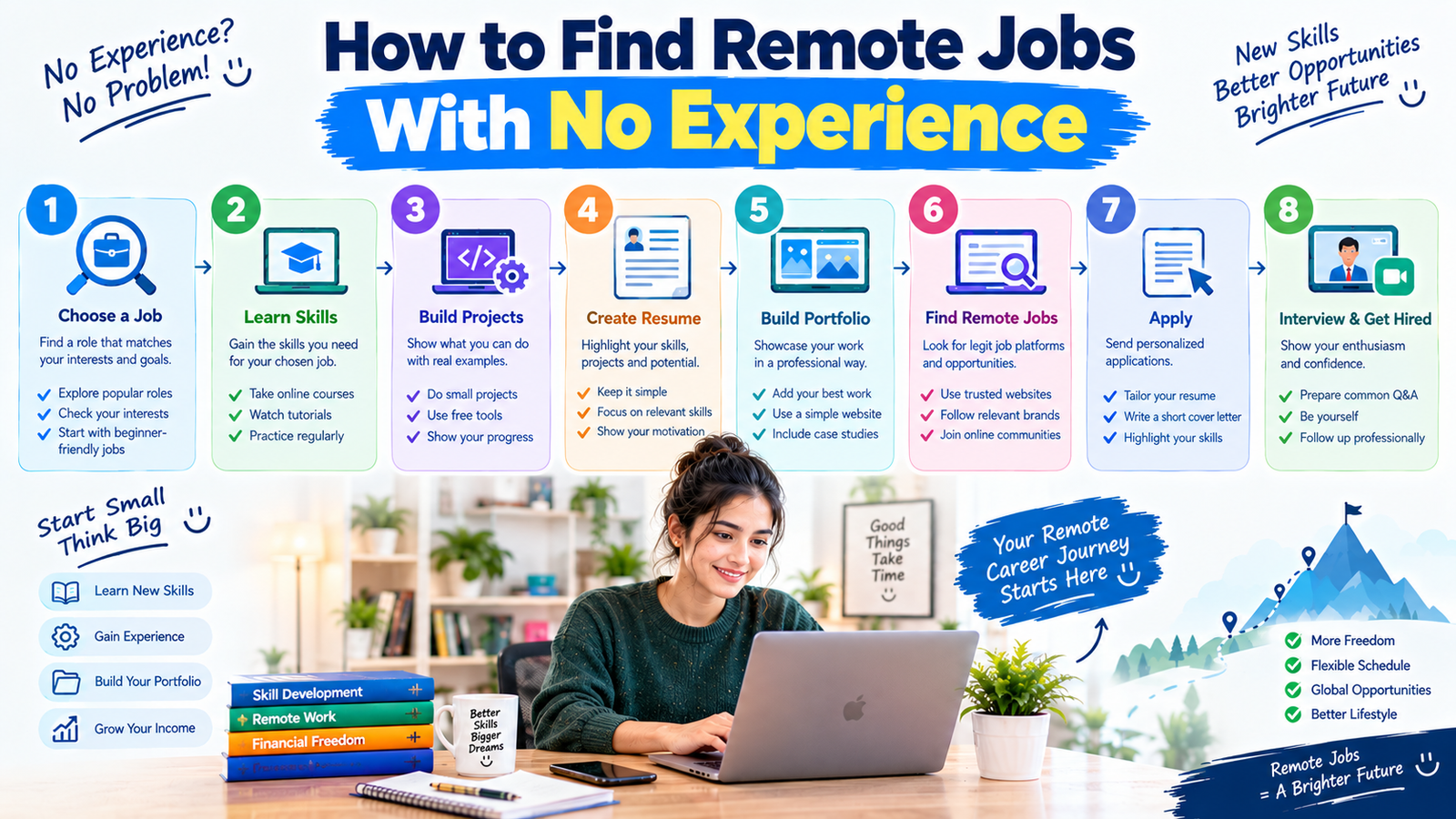
Choose a Job → Learn Skills → Build Projects → Create Resume → Build Portfolio → Find Jobs → Apply → Interview → Get Hired
This process can take time, but it gives you a clear direction.
How to Avoid Remote Job Scams
Unfortunately, fake remote jobs are common.
Be cautious when a job offer:
- Guarantees unusually high income for very little work
- Asks you to pay money before starting
- Requests sensitive financial information too early
- Uses suspicious email addresses
- Has no clear company information
- Pressures you to make a quick payment
- Promises a job without an interview or evaluation
Research the company independently before sharing sensitive information.
A legitimate employer should be able to explain the role, responsibilities, hiring process, and compensation clearly.
How Many Jobs Should You Apply For?
There is no magic number.
Quality is generally more useful than sending hundreds of identical applications.
For example, you might set a weekly goal of submitting several carefully targeted applications.
Track:
- Company name
- Position
- Application date
- Job link
- Resume version
- Response
- Interview status
This helps you understand what is working.
What If You Keep Getting Rejected?
Rejection is normal when searching for your first remote job.
>If you are not getting interviews, review your resume and portfolio.
>If you are getting interviews but no offers, work on your interview skills.
>If you are applying for jobs that require skills you don’t have yet, spend more time learning and practicing.
>Think of the job search as a process you can improve rather than a single yes-or-no event.
A 30-Day Plan for Finding a Remote Job
You can use the following simple plan.
Week 1: Choose and Learn
Pick one job category and learn the essential skills.
Week 2: Build Your Proof
Create three to five practical projects that demonstrate your abilities.
Week 3: Prepare Your Application
Create your resume, portfolio, professional profile, and application message.
Week 4: Apply Consistently
Search for suitable positions and submit customized applications every day or several times per week.
Continue improving your skills while you apply.
Final Thoughts
Finding remote jobs with no experience is possible, but it requires a smart strategy and patience.
You do not need to wait until you have years of professional experience. Start by choosing one job category, learning the required skills, creating practical projects, and building a professional resume and portfolio.
Virtual assistance, customer support, data entry, content writing, social media assistance, tutoring, and junior technology roles can provide potential starting points depending on your skills and the requirements of the employer.
Most importantly, avoid shortcuts and suspicious job offers. Focus on building real skills and applying to legitimate opportunities.
Your first remote job may not be your dream job, but it can give you the experience needed to move toward better opportunities in the future.